
There is no official statistic of what it costs to renovate a house per square metre in Italy. Neither Istat nor the Agenzia delle Entrate publishes one, and the ranges you find online come from building firms’ own websites. What does exist is the Tuscany Region’s official price list, which fixes what each item of work is worth in 2026.
Key takeaways
- Italy publishes no official average renovation cost per square metre. The figures circulating online come from commercial sites with no stated method or sample, and they contradict each other by three to four times.
- Il Prezzario dei Lavori 2026 della Regione Toscana, the region’s official price list approved by regional decree 1676 of 15 December 2025, does publish unit prices province by province: relaying a roof with its own reclaimed tiles is 46.06 euro per square metre, external insulation 85.00 euro per square metre. These are public works rates, net of VAT, and they already include 16 percent overheads and 10 percent contractor’s profit.
- The reduced 10 percent VAT applies to the building contract, not to your whole budget: professional fees are at 22 percent, and so are raw and semi-finished materials, which on a farmhouse means the roof tiles, the bricks and the terracotta.
- The renovation tax deduction for spending in 2026 is 50 percent for a main home and 36 percent for a second home, on a ceiling of 96,000 euro. A holiday home is never a main home, and a non resident usually has no Italian income tax to set it against.
- A permanent pool needs a permesso di costruire in Tuscany, even as a private garden feature (Regional Law 65/2014, article 134), and in a protected landscape it goes through the ordinary authorisation procedure, not the fast one.
- Beyond 2,000 metres from the nearest substation, a house that is not your registered residence leaves the standard electricity connection regime altogether and pays the actual cost of the works plus 20 percent, with no cap.
Why is there no average cost per square metre?
Because nobody official measures the total. Official references do exist, but for individual items of work: the regional price lists, and the ministerial ceilings for energy efficiency works. What nobody publishes is the average cost of renovating a dwelling. Istat produces cost indexes, which track percentage variations and not euro levels, and the OMI database of the Agenzia delle Entrate gives property market values, not building costs. The ranges you meet when you search, 800 to 2,500 euro per square metre and similar, come from builders’ and quote-portals’ own marketing pages: none of them declares a sample or a method, and they disagree with each other by a factor of three or four. We do not publish them, and you should treat them the way we do.
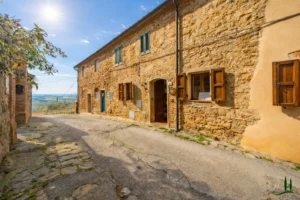
There is also a reason specific to a farmhouse. On a stone building the budget is dominated by the roof and by the structure, and those depend on the condition of that particular building, not on its floor area. Two identical 300 square metre farmhouses, one with a sound roof and one that needs the timbers replaced, are not the same job at all.
One thing is worth knowing about the 2026 edition of the Tuscan list, because it tells you how fresh these numbers are. The Region did not re-survey every item this year: its own survey found no sharp increases, so it uprated the existing entries by 1.2 percent, in line with consumer prices. The rates below therefore reflect mid 2025 market conditions.
What does the official Tuscan price list say?
The Region of Tuscany publishes a full price list every year, item by item, with separate prices for each province, and the differences between provinces are small. It is public, free and citable, and you can hold a builder’s quote up against it. These are the figures for the province of Siena in 2026.
| Work | Official 2026 unit price |
|---|---|
| Relaying a roof with tiles reclaimed from the same roof, stripping out priced separately | 46.06 euro / m² |
| New roof covering, coppi and controcoppi | 64.13 euro / m² |
| Removing an old timber roof structure | 380.61 euro / m³ |
| Structural stitching, scuci e cuci, on solid brick masonry | 1,956.40 euro / m³ |
| The same on foundations | 2,193.50 euro / m³ |
| Ring beam tying the walls to the floor structure | 544.32 euro / m³ |
| Carbon fibre reinforcement | 187.84 euro / m² |
| Cutting a new opening through a stone wall | 907.07 euro / m³ |
| External insulation, 60 mm | 85.00 euro / m² |
| Lime plaster, internal walls | 27.79 euro / m² |
| Laying a terracotta floor, tiles not included | 16.57 euro / m² |
| One surface mounted lighting point, builder’s work excluded | 49.36 euro each |
| Three chamber septic tank, 3,000 litres, excavation excluded | 1,964.95 euro each |
| Scaffolding, erection including the first month | 17.13 euro / m² |
| Scaffolding, each further month | 2.35 euro / m² |
Read these as a reference point for a conversation with your builder, not as a quote, and read the exclusions as carefully as the prices. This is the list used for public contracts, it assumes normal working conditions, and it does not cover connected or complementary works. A private site at an isolated farmhouse, with a difficult access and a landscape restriction on top, sits structurally above these numbers.
Two entries need a warning of their own. The structural stitching rates are the only ones the list publishes, and they are written for solid brick masonry: a Tuscan farmhouse is stone, so your engineer will have to build a specific price analysis for it, and these figures are only the order of magnitude. And external insulation, which looks like an easy energy saving on paper, is normally not authorised on a stone farmhouse under landscape protection, so budget for internal solutions instead.
Which items blow up the budget on a stone farmhouse?
The two that decide everything are the roof and the structure. A roof that only needs relaying with its own tiles is a manageable line, and one that needs the timbers out and replaced is another order of magnitude, as the price of removing the old structure alone suggests. Structural consolidation is the other: scuci e cuci, the technique of dismantling and rebuilding a damaged section of wall stone by stone, is priced by the cubic metre and it adds up quickly on a large building.
Then come the ones buyers forget. Rising damp in stone walls, which is normal in a building that has stood empty. Every new window or door cut through a metre thick wall. A full set of systems, since an old farmhouse rarely has anything worth keeping. Bespoke wooden windows, which are made to measure. A septic tank, because in open countryside there is no mains drainage, and the excavation for it is a separate line. And scaffolding, which is charged to erect and then hired by the month: on a job that runs long it becomes a real line of its own, and it is the one nobody budgets for.
The electricity connection deserves a paragraph of its own, because it is the item that can change a decision. Charges are set by the national regulator, not by the utility: a fixed component, an amount per kilowatt, and a distance component measured in a straight line from the nearest substation. The first 200 metres are included, and beyond that you pay by bands that double, and double again, as the distance grows. The threshold that matters is 2,000 metres: past it, a house that is not your registered residence stops being a standard connection altogether, and the distributor charges the full actual cost of the works plus 20 percent overheads, with no ceiling, and may offer you a local generator instead of a connection to the grid. A landscape restriction that forces the cable underground doubles the distance component. If the property sits a long way down an unmade track, ask for a written connection quote before you sign, not after.
How much VAT do you pay on the work?
The building contract for restoration and renovation work is charged at the reduced rate of 10 percent. That is not the same as 10 percent on your whole budget, and the difference is worth real money on a farmhouse.
Professional fees, so your architect, geometra or engineer, are always at 22 percent, even within a recovery project. Raw and semi-finished materials are also at 22 percent, and on this kind of building that means precisely the things you will buy most of: roof tiles, bricks and terracotta. Finished goods that keep their identity, such as doors, windows, sanitary ware and boilers, do qualify for the reduced rate on a restoration or renovation, and here is a detail worth knowing, because it works in your favour: on this category they keep the 10 percent even when you buy them yourself rather than through the firm doing the work.
One more thing decides the rate, and it is decided before the site opens: how the building title classifies your works. If the job is filed as maintenance rather than as restoration or renovation, a separate rule on expensive items comes back into play and part of your bill moves to 22 percent. Agree the classification with your professional before you sign anything. Our guide to the cost of buying property in Italy covers the taxes on the purchase itself, which are a separate matter.
Can a foreign buyer use the Italian renovation tax deduction?
In law yes, in practice usually not, and this is one of the more expensive misunderstandings we come across. Italy does grant a renovation deduction, and the Agenzia delle Entrate states that it is available to all income tax payers, whether or not they are resident in Italy. The catch is in what the deduction actually is: it comes off your Italian gross income tax in ten equal annual instalments, and an instalment that finds no tax to reduce is simply lost, because it cannot be refunded and cannot be carried forward.
Most foreign owners of a Tuscan holiday home have no Italian income tax for it to reduce. A second home that is not let produces no income tax base, since the IMU property tax replaces it, and letting the house under the flat rate cedolare secca regime does not help either, because that is a substitute tax rather than ordinary income tax. If you do have Italian taxable income, from a long let taxed in the ordinary way or from work in Italy, the deduction becomes worth planning around.
The rate is also lower than the one you will read in most headlines. For spending in 2026 it is 50 percent for a main home, meaning the property where you or your family actually live, and 36 percent for everything else, on a ceiling of 96,000 euro per unit. A farmhouse bought as a holiday home is never a main home, so the number that applies to it is 36 percent. The shortcuts that once made all this painless are also gone: the invoice discount and the sale of the tax credit were closed to ordinary renovation work in February 2023, and the last exceptions were removed in March 2024, so the ten year deduction is now the only route. Confirm your own position with an Italian accountant before you count on any of it.
What permits will you need?
It depends on the work, and on where the house is. As a national baseline, new bathrooms and new systems are normally a CILA, a notification filed before the works begin; opening a new window in a facade is typically a SCIA, though comuni treat this differently and it is worth asking; adding volume needs a permesso di costruire, the planning permission proper; and converting an agricultural outbuilding into living space is a change of use that national law does not liberalise, so it needs planning permission and follows regional and municipal rules.
That is only the baseline. In Tuscany the Region and your own comune have the final word, and on a country property there is usually a further layer: anything that changes the external appearance of a building in a protected landscape, which covers most of the Tuscan countryside, needs an autorizzazione paesaggistica, the landscape authorisation. Allow three to four months for the ordinary procedure, and plan around it. The comune has 40 days to check the file and send its proposal to the Soprintendenza, which then has 45 days to give its opinion, and only then does the comune issue the authorisation. Lighter works, listed by decree, run on a simplified route that is meant to close in 60 days overall. Work inside the house that does not alter the state of the place or its external appearance is exempt from the procedure altogether. Our guide to buying property in the Val d’Orcia goes through this in more detail for the protected valley.
The swimming pool is the one that surprises almost every foreign buyer. In Tuscany a permanent pool counts as a permanent transformation of undeveloped ground, expressly including a pool built as a private garden feature of the house, so the rule is a permesso di costruire (Regional Law 65/2014, article 134). A genuinely removable seasonal pool may fall outside. And here is the part that costs time rather than money: pools are not on the list of works that qualify for the simplified landscape route, so under a landscape restriction they go through the ordinary procedure, with the timetable described above. Budget for that from the start.
Two more things to plan for. If the building carries unregularised works from the past, which on an old farmhouse is common rather than exceptional, there is now a dedicated route to put them right, introduced in 2024: the decision takes up to 180 days, with the Soprintendenza giving its opinion within 90. And at the end of the job, a building undergoing major renovation, which the law defines as works on more than 25 percent of its envelope, needs an APE, the energy performance certificate, before it can be signed off as habitable. The certificate must be updated whenever works change the building’s energy class, and you will need it again the day you sell or let the house. Before you commit to a project, have a local geometra, the Italian building surveyor who normally handles this paperwork, check what your specific property allows.
Who do you need on site, and what do they charge?
A restoration usually involves a geometra or an architect for the design and the permits, a structural engineer where the building needs consolidation, a direttore dei lavori, the professional who supervises the site on your behalf, and the building firm itself.
Compulsory professional tariffs were abolished in 2012, so no percentage is binding on a private client. What the law requires is that the professional gives you, in writing or in digital form and before accepting the engagement, a preliminary estimate, with the fee then agreed item by item including expenses and statutory contributions. In practice most professionals still quote from the ministerial parameters, which on a project of this size tend to work out around 9 to 10 percent of the value of the works. Ask for the estimate, compare two or three, and remember the 22 percent VAT on those fees when you set them against the 10 percent on the building contract.
How long does it take?
Longer than the building work itself, and honestly, no one publishes reliable statistics on this, so we will not invent an average. What we can tell you is what stretches the calendar: the permits, and in protected areas the landscape authorisation, which on the ordinary route runs three to four months before a spade goes in the ground; the weather, since roof work is seasonal; and the lead time on anything made to measure, which for hand made wooden windows is months rather than weeks. Plan the project around those three, and treat the builder’s own estimate as the shortest of the possible outcomes.
Or you could buy one already restored
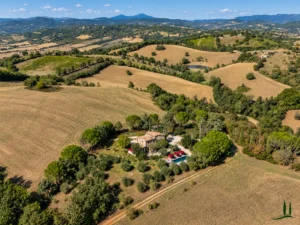
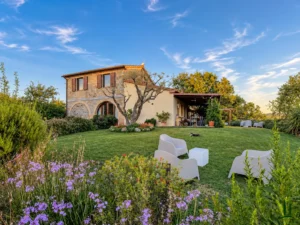
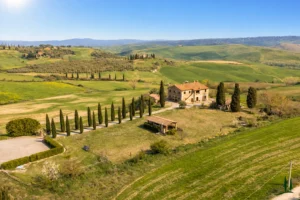
This is worth saying plainly, because it is the honest alternative. Almost everything in our current catalogue is already restored, which is what most of our buyers actually want: the stone, the beams and the terracotta, without a building site and without a project to manage from another country. An authentic stone farmhouse with an olive grove in the Maremma asks about 650,000 euro, a panoramic farmhouse twelve kilometres from Lucca the same, and a rustic house in the hills with a pool about 720,000 euro. These are single properties, not a market average.
If a project is what you want, we can look for one: unrestored farmhouses do come up, and finding the right one is exactly what our property finding service is for. For where to look, our guides to the Maremma toscana e il cheapest areas to buy in Tuscany are the place to start, and if you plan to let the finished house, our guide on renting out a Tuscan property and the CIN code explains the rules.
Domande frequenti
How much does it cost to renovate a farmhouse in Tuscany?
There is no official average per square metre, and the ranges published online come from commercial sites with no stated method. What is official is the Tuscany Region’s 2026 price list, which sets each item of work: relaying a roof with its own reclaimed tiles at 46.06 euro per square metre, external insulation at 85.00 euro per square metre, lime plaster at 27.79 euro per square metre, in the province of Siena, net of VAT. Your own cost depends on the condition of the building, above all its roof and its structure.
Is there an official price list I can check a builder’s quote against?
Yes. The Prezzario dei Lavori 2026 della Regione Toscana is public and free, it covers every province, and it is the reference used for public works. It will not tell you what your house will cost, and its rates assume normal working conditions, but it tells you what each item of work is officially worth, which is enough to have a serious conversation about a quote. Read the exclusions with the prices: many entries cover the labour and not the material.
What VAT rate applies to renovation work in Italy?
Ten percent on the building contract for restoration and renovation work. It is not a blanket 10 percent on the whole budget: professional fees are at 22 percent, and so are raw and semi-finished materials such as roof tiles, bricks and terracotta. Finished goods such as doors, windows, sanitary ware and boilers keep the 10 percent, even when you buy them directly. How your building title classifies the works can change the outcome, so agree it before you start.
Can I claim the Italian renovation deduction if I do not live in Italy?
You are entitled to it, but it is usually worth little. The deduction reduces Italian gross income tax over ten years, and an annual instalment that meets no tax is lost, since it cannot be refunded or carried forward. A holiday home that is not let generates no Italian income tax base, because IMU replaces it. The rate on a second home is 36 percent for 2026 spending, not the 50 percent that applies to a main home.
Do I need planning permission for a swimming pool?
For a permanent pool, yes. In Tuscany it counts as a permanent transformation of undeveloped ground, expressly including a pool built as a private garden feature, so the rule is a permesso di costruire (Regional Law 65/2014, article 134). A genuinely removable seasonal pool may fall outside. Under a landscape restriction a pool does not qualify for the simplified authorisation route, so allow three to four months for the ordinary procedure.
Is it cheaper to buy a farmhouse already restored?
Often, once you count the whole picture: the works, the professional fees, the permits, the months of supervision from abroad and the cost of not being able to use the house meanwhile. A restoration makes sense when you want a specific result and you are ready to manage the process. If you are not, buying a house someone else has restored is usually the calmer and more predictable route.
How we can help
Easy Living Tuscany is a boutique agency working across southern Tuscany, and we see both sides of this: the restored farmhouses we sell, and the projects buyers ask us to find. If you want us to look for a property, restored or to restore, use our property finding service, browse what is currently for sale, o Prenota una chiamata and we will give you an honest read on what a specific building would take. For the wider picture, start with our complete guide to buying property in Tuscany.
These figures are indicative and drawn from published sources, confirm your specific case with your surveyor, architect, notary or tax advisor before you budget on them.
Last updated September 2026. Written by Alessandro Ciacci, Co-founder, Easy Living Tuscany.