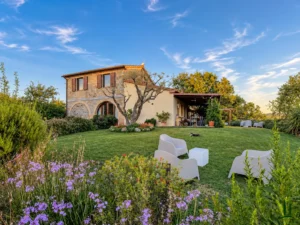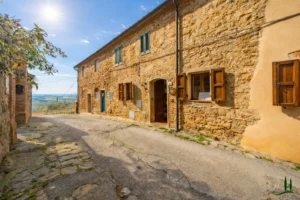

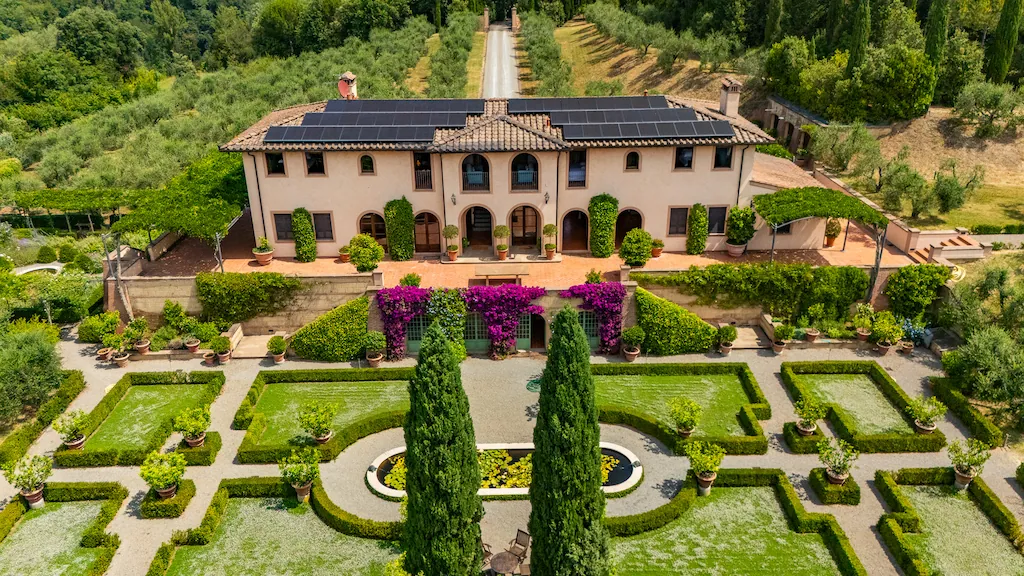
Buying a house in Tuscany is simpler than most people expect, and more technical than most people are told. There is no restriction on foreign ownership for buyers from the great majority of countries, the process is protected by a public notary, and the purchase taxes are often lower than the ones you pay at home. What catches people out is everything around the purchase, the planning compliance of an old farmhouse, the difference between the asking price and the taxable value, the real running costs of a country estate with a pool and two hectares of garden.
This guide walks through the whole journey, from the first question to the keys, with the numbers and the documents that actually matter. Every figure below is sourced and dated, so you can check it yourself. Figures verified in July 2026.
The Tuscan market in 2026, in five numbers
- 51,566 homes changed hands in Tuscany in 2025, up 9.4% on 2024, a rise well above the national increase of 6.4%. Source, Agenzia delle Entrate, Real Estate Report 2026, published 21 May 2026.
- House prices in Italy rose 5.2% year on year in the first quarter of 2026, provisional data. Across the whole of 2025 the increase was 4.0%. Source, Istat.
- Tuscany is the region most searched by foreign buyers, with 14.77% of all enquiries for Italian property in 2025, ahead of every other region. Source, Gate-away.com annual report, January 2026. These are enquiries, not completed sales.
- The United States is the first country of origin, with 25% of foreign enquiries, and the United Kingdom grew 23.23% in 2025 to become the second market.
- The average value of the property foreign buyers are looking for is €428,622, up 1.27% on the previous year.
In short, a market with rising volumes, moderate price growth and a strong international bias, in which Tuscany remains the first choice.
Can a foreigner buy property in Italy?
In almost all cases, yes. Italian law treats buyers in three groups.
- EU and EEA citizens buy with the same rights as an Italian citizen. No permit, no special authorisation.
- Non EU citizens legally resident in Italy, holding an EU long term residence permit or a permit for work, self employment, business, family, humanitarian or study reasons, also buy with full rights.
- Non EU citizens living abroad come under the reciprocity condition set by article 16 of the preliminary provisions to the Civil Code, which means Italy allows what your country allows to Italians. The notary verifies it case by case, using the country files published by the Italian Ministry of Foreign Affairs.
What that means in practice for our most frequent clients. For United States buyers the Ministry’s country file records no particular restriction on Italians buying real estate in the United States. For Australian buyers reciprocity rests on article 28 of the 1967 Canberra Agreement. For Swiss buyers it is recognised only within the limits of the Swiss LAFE rules, so not where the purchase is a pure capital investment. For United Kingdom buyers the position after Brexit depends on whether they are covered by the Withdrawal Agreement, the Ministry’s country file has not been updated since 2020, and the notary will confirm it before the deed. In our experience this has never blocked a British purchase, but it is a checkbox, not an assumption.
What you need before you start
- Codice fiscale. The Italian tax code, free, issued by the Agenzia delle Entrate or by an Italian consulate abroad. Nothing can be signed or registered without it.
- An Italian bank account. Not legally compulsory, but strongly advisable. Utilities, local taxes and the balance at the deed are far easier to handle from an Italian IBAN, and notaries generally prefer domestic bank drafts.
- A valid passport or ID and, if you are married, clarity on your matrimonial property regime, because it is declared in the deed and it decides who legally owns the house.
- A power of attorney if you cannot be in Italy on the day of the deed. It is a normal, well established option, prepared in advance with the notary.
- Language. If you do not speak Italian the deed is executed with an interpreter and, where required, a sworn translation. The notary confirms what is needed in your specific case.
What a house in Tuscany actually costs
Tuscany is not one market, it is at least six, and the spread between them is wide. The tables below show the average asking price per square metre from the two largest Italian property portals, side by side, for June 2026. We show both because their listing panels differ, and we do not average them.
By province, June 2026, €/m²
| Province | idealista | immobiliare.it |
|---|---|---|
| Tuscany, region | 2,464 | 2,664 |
| Lucca | 3,302 | 3,691 |
| Florence | 3,230 | 3,386 |
| Grosseto | 2,453 | 2,692 |
| Siena | 1,888 | 2,029 |
| Pisa | 1,853 | 1,959 |
| Arezzo | 1,442 | 1,535 |
One figure in that table looks wrong and is not. The province of Lucca is more expensive than the city of Lucca, because the provincial average is pulled up by the Versilia coast, where Forte dei Marmi alone is quoted above €11,000 per square metre.
Selected towns, June 2026, €/m²
| Town | idealista | immobiliare.it |
|---|---|---|
| Florence, city | 4,623 | 4,735 |
| Fiesole | 3,749 | 4,117 |
| Siena, city | 2,930 | 2,963 |
| San Casciano in Val di Pesa | 2,613 | 2,626 |
| Greve in Chianti | 2,524 | 2,763 |
Sources, idealista price report and immobiliare.it market data, June 2026, consulted 21 July 2026. These are asking prices from listings, not recorded transaction values, and they are averages across the entire residential stock, town flats included. They are not a valuation benchmark for country estates, farmhouses or historic villas, which trade well above these figures. For recorded transaction values by zone, the official source is the OMI database of the Agenzia delle Entrate. We deliberately leave out year on year percentages, because the two portals disagree on the direction of the change in several municipalities, and a small sample does not make a trend.
Choosing your part of Tuscany
This is the decision people regret when they get it wrong, far more than the price. Spend your time here.
Chianti and the Siena hills
The classic image, vineyards, cypress lined drives, stone farmhouses, small walled towns. Excellent restaurants and wineries, an established international community, thirty to sixty minutes from Florence. It is the most sought after rural market in the region and the one with the strongest resale demand. Example from our portfolio, a medieval castle in the heart of Chianti Classico.
Val d’Orcia and the south of Siena
Montalcino, Montepulciano, Pienza, a UNESCO landscape of rolling clay hills and some of the best wine in Italy. Quieter than Chianti, better value per square metre, superb light for anyone who cares about views. Example, a villa in Montalcino with views over the Val d’Orcia.
Maremma, the province of Grosseto
The wild south, thermal springs at Saturnia, Etruscan villages, olive groves, and the sea within half an hour. It is where a country budget goes furthest, and it is the area we know best. Example, an authentic stone farmhouse with its own olive grove.
Florence and its immediate hills
For buyers who want city life, or an estate with the city in reach, this is the premium end, and the table above shows it. City apartments hold value exceptionally well and rent easily. Example, a 14th century grand estate just outside Florence.
Pisa, Lucca and the western hills
Underrated, and the best value of the areas above once you leave the coast. Two airports within an hour, a serious food culture, the sea nearby. Example, a 30 hectare estate with olive grove and panoramic pool.
Our advice is always the same, choose the area with your calendar in hand. How often will you come, for how long, in which months, with how many guests, and how far are you willing to drive from the airport with luggage and children. The answer usually eliminates half of Tuscany in ten minutes.
Purchase taxes, with real numbers
Start from the default, because most foreign buyers fall into it. Buying a home from a private seller, without first home relief, you pay registration tax at 9%, plus a fixed €50 mortgage tax and €50 cadastral tax. With first home relief the 9% becomes 2%. The proportional registration tax cannot be less than €1,000, although the amount actually paid can be lower once you deduct tax already paid on the deposit at the preliminary contract, and any first home tax credit.
The detail that saves foreign buyers the most money
The taxable base is not automatically the price. Under the prezzo-valore system the tax is calculated on the cadastral value, which is normally far below the market price. It is not automatic, and this is where people lose it, the buyer must expressly request it from the notary in the deed itself. It applies only to residential property and its appurtenances, only where the buyer is an individual not acting in the course of a business or profession, and only to sales that are not subject to VAT. Buy through a company and the option is not available to you.
The cadastral value is the cadastral income, the rendita catastale, uplifted by 5% and then multiplied by 110 for a first home, or by 120 in all other cases.
A worked example on a farmhouse with a rendita catastale of €1,200, assuming a private seller and the prezzo-valore option.
| First home | Holiday home | |
|---|---|---|
| Taxable value | €138,600 | €151,200 |
| Rate | 2% | 9% |
| Registration tax | €2,772 | €13,608 |
| Fixed taxes | €100 | €100 |
| Total purchase tax | €2,872 | €13,708 |
The same property might be on the market at €650,000. That is why the first document we ask a seller for is the cadastral record, and why we can give a buyer an exact tax figure before any offer is made.
Who actually qualifies for the 2% rate
Treat 9% as your working assumption and 2% as a conditional benefit, because most holiday home buyers do not qualify. First home relief requires the property to be in the municipality where you are resident, or where you undertake to move your residence within 18 months of the purchase, and that undertaking must be stated in the deed itself, otherwise the relief is lost. Residence is not the only route, the relief also applies if the property is in the municipality where you carry out an activity, including study or voluntary work, and there is a separate rule for people who moved abroad for work after at least five years of residence or activity in Italy. Missing the eighteen month deadline costs you the relief plus interest and a 30% penalty, although the undertaking can be revoked before the deadline without penalty.
Two more conditions worth knowing. If you already own another home in the same municipality bought without relief, the relief is not available at all, and the earlier home must be sold before the new purchase. If the home you already own was bought with relief, you can buy again with relief provided you sell the old one within two years, a deadline raised from one year with effect from 1 January 2025.
Luxury cadastral categories, the trap in our segment
First home relief is never available for property in cadastral categories A/1, stately homes, A/8, villas, and A/9, castles and historic palaces. A great many Tuscan villas are classified A/8. Check the cadastral category before you assume any reduced rate, it is one line in the cadastral record and it changes the arithmetic completely.
If the seller is a company
The general rule is the opposite of what most buyers expect, a sale by a company is normally exempt from VAT, so you pay registration tax at 9%, or 2% with relief, plus the €50 and €50. VAT applies only in specific cases, typically a sale by the building or renovating company within five years of completion, or later than five years if the seller opts for VAT in the deed or in the preliminary contract. Where VAT does apply it is 10%, 4% with first home relief, and 22% for the luxury categories A/1, A/8 and A/9, and registration, mortgage and cadastral taxes are €200 each. Note that with VAT the taxable base is the price, not the cadastral value, and the prezzo-valore option is not available.
Source for this whole section, Agenzia delle Entrate, the official guide to buying a home and the related tax reliefs, October 2025 edition. Figures are indicative and every property has its own history, so confirm your specific case with your notary.
The other costs
- Notary, a public officer, not your lawyer, chosen and paid by the buyer. The fee depends on the value and complexity of the deed and includes registration and the searches.
- Agency commission, in Italy it is customary for both buyer and seller to pay the agency, a percentage of the price plus VAT, agreed in writing before the offer.
- Technical survey, a geometra or architect who checks that what is built matches what was authorised. On an old country property this is the best money you will spend in the entire transaction.
- Translation and interpreter, where the buyer does not speak Italian.
The purchase process, step by step
1. The offer, proposta irrevocabile d’acquisto
A written offer, valid for a set period, accompanied by a deposit cheque that is not cashed until the seller accepts. Here is the asymmetry nobody explains, and it matters, once signed, the proposal binds only you as the buyer, while the seller remains free to consider other offers until acceptance. When the seller does accept, the proposal automatically converts into a preliminary contract, which binds both parties to complete. Source, Consiglio Nazionale del Notariato. The practical consequence is that conditions belong in the proposal, not in a later conversation, financing, technical checks and the cancellation of any mortgage on the seller’s side.
2. The preliminary contract, compromesso
The real contract. It fixes price, completion date and penalties, and it is normally accompanied by a deposit, the caparra confirmatoria, in our experience typically between ten and twenty per cent, which is market practice rather than a rule. The protection works both ways under article 1385 of the Civil Code, if the buyer defaults the seller keeps the deposit, if the seller defaults the buyer can withdraw and demand double the deposit. That said, the double is not automatic in every scenario, the party who is not in default can instead ask for the contract to be enforced or terminated, in which case damages follow the ordinary rules, and the two remedies cannot be combined.
The preliminary contract must be registered with the tax authorities within 30 days of signature, with €200 of registration tax plus stamp duty. Registration is compulsory. Transcription in the land registry, under article 2645-bis of the Civil Code, is a different and optional step, and it is the one that protects you against anything happening on the seller’s side between the preliminary contract and the deed. On a long completion, ask for it.
3. The checks, between compromesso and deed
This is where professionals earn their fee, and where a Tuscan farmhouse differs from a new build anywhere else.
- Energy certificate, the APE. Compulsory. It must exist, be handed to the buyer and be attached to the deed, which must also contain a clause confirming the buyer received it. A missing attachment does not void the sale, but it carries an administrative fine of €3,000 to €18,000, owed jointly and in equal shares by both parties, seller and buyer. Article 6 of Legislative Decree 192/2005.
- Cadastral conformity. On pain of nullity, the deed must contain the cadastral identification, a reference to the plans filed with the Land Registry, and a declaration by the owners that data and plans match the actual state of the property, a declaration that can be replaced by a certificate from a qualified surveyor. The nullity is formal, it is triggered by the absence of the declaration, not by the discrepancy in itself, but a false declaration carries civil and tax consequences. Article 29, paragraph 1-bis of Law 52/1985, recently confirmed by the Court of Cassation in decision 27531 of 15 October 2025.
- Planning compliance. For buildings begun after 17 March 1985, the deed is void unless it states the reference numbers of the building permit, or of the retrospective permit. If the permit existed and was simply not mentioned, the deed can be cured afterwards. If no permit ever existed, there is no cure, the irregularity has to be regularised first, through the procedure under article 36 of Presidential Decree 380/2001, or, for partial discrepancies and material variations, under the new article 36-bis introduced by the 2024 Salva Casa decree. Either the person who carried out the works or the current owner can apply. Who pays for the regularisation is negotiated between the parties and normally settled in the preliminary contract.
Older Tuscan farmhouses have often been extended over decades, sometimes generations. Ninety per cent of the problems we see in a transaction are here, not in the price.
4. The deed, rogito
Signed before the notary, who reads the deed aloud, verifies identities and, where relevant, the reciprocity condition, collects the taxes and registers the transfer. Payment is made in traceable form, usually bank drafts, and the keys change hands at the table. In our experience the whole journey from accepted offer to deed takes two to four months, faster with no mortgage, longer where planning regularisation is needed or where several heirs share the ownership.
Financing, if you need a mortgage
There is no legal bar to a non resident foreign buyer taking an Italian mortgage, but lending criteria are more conservative. Brokers and specialist lawyers typically report loan-to-value ratios for non residents in the range of 50% to 70%, so a deposit of 30% to 50%, against a general ceiling of 80% for residents, with terms of 20 to 25 years and an instalment capped at roughly 30% of income. These are market ranges, not rules, and each bank sets its own conditions.
For context, the average rate on new mortgages for house purchase in Italy was 3.48% in June 2026, source ABI, and 45.9% of homes bought by individuals in 2025 were financed with a mortgage, with an average loan of €141,400, source Agenzia delle Entrate, Real Estate Report 2026. Start the conversation with a bank or a broker before you make an offer, not after, and write the financing condition into the proposal.
What it costs to own a house in Tuscany
The annual budget matters more than the purchase tax, because it repeats every year.
- IMU, the municipal property tax. The basic rate for property other than a main residence, which includes every holiday home, is 0.86% of the cadastral taxable base, and each municipality can move it anywhere between 0% and 1.06%, so the effective rate depends on the comune. It is due from the owner, or the holder of a right such as usufruct, not from the occupant, so you pay it even when the house is let. It is paid in two instalments, by 16 June and 16 December, or in one payment by 16 June.
- A distinction that costs people money. A main residence is exempt from IMU, but for IMU purposes a main residence means registered residence and habitual dwelling. A foreign buyer with a holiday home in Tuscany pays IMU whatever the cadastral category. Do not confuse this with the first home relief on purchase taxes, they are different rules with different conditions. The exception, a main residence in categories A/1, A/8 or A/9 is not exempt, it pays a reduced 0.5% with a €200 deduction.
- TARI, the waste collection tax, a fixed part based on the floor area and a variable part based on the number of occupants. The trap for our clients is who pays it, normally the occupier of a property let for more than six months, but where the property is occupied for no more than six months in the calendar year, which is exactly the case with seasonal and holiday letting, TARI is owed by the owner.
- Utilities, electricity, water, gas or LPG, plus wood or pellets for winter, since many country houses heat with a combination.
- Maintenance, the pool, the garden, the olive grove, the private road. A pool needs opening, weekly attention through the season and winterising. An olive grove needs pruning and a harvest.
- Property management, if you are abroad for most of the year somebody local has to hold keys, meet the plumber and check the house after storms. Budget for it honestly, it is what keeps a Tuscan house in good condition.
Renting the house out when you are not there
Many of our buyers cover a meaningful share of their running costs with holiday lettings, and Tuscany has one of the strongest short stay markets in Europe, concentrated between May and September. The rules changed recently and they are now enforced, so read this part before you count on rental income.
- The CIN, Codice Identificativo Nazionale. A national identification code, applicable since 2 November 2024, with penalties in force since 2 January 2025. It is required of hotel and non hotel accommodation operators, of anyone letting a property for tourist purposes, and of anyone letting under the short letting rules. Note that tourist letting includes stays longer than 30 days.
- Two obligations, not one. The code must be displayed on the outside of the building, with alternative arrangements available where a condominium rule or a landscape protection constraint prevents a sign, which is common in Tuscany, and it must appear in every listing, wherever published. The obligation to show the code in the listing falls on agencies and platforms too.
- Penalties. Letting without a CIN, €800 to €8,000, graduated by the size of the property. Failing to display it or to show it in listings, €500 to €5,000 for each property, with immediate removal of the listing.
- Safety equipment. Properties let short term must have working gas and carbon monoxide detectors and portable fire extinguishers, minimum rating 13A, minimum charge 6 kg or 6 litres, one every 200 m² or part thereof and at least one per floor.
- Regional rules apply on top. Tuscany has its own regional identification codes and reporting requirements, and guest details must be reported to the police. Income from letting is taxable in Italy, and a local accountant will tell you which regime suits you.
Source, Ministry of Tourism, FAQ on the national accommodation database, and article 13-ter of Decree Law 145/2023.
We run a rental division for exactly this reason, so we can tell a buyer, before the offer, what a specific house is realistically likely to earn in a season.
Five mistakes we see foreign buyers make
- Falling in love before reading the planning file. A beautiful farmhouse with an unauthorised extension cannot be sold, mortgaged or insured properly until it is regularised.
- Assuming the 2% rate. Most holiday home buyers pay 9%, and an A/8 villa can never qualify for relief. Budget on 9% and treat anything less as good news.
- Underestimating the drive. Twenty kilometres of white gravel road is charming in June and exhausting in February with a car full of luggage.
- Signing a proposal without conditions. It binds you before it binds the seller, so financing and technical checks belong in the text.
- Buying without local eyes. Water supply, internet coverage, neighbouring agricultural activity and winter access are things you cannot see in photographs.
How we can help
We are a boutique agency based in Tuscany. You can browse what we currently have for sale, or, if nothing matches, we can search for you, including properties that are not publicly advertised, through our property finding service.
The simplest first step is a conversation, so we can understand your calendar, your budget and the compromises you are willing to make. You can book a call with one of our agents at a time that suits you, in English, Italian or German.
Frequently asked questions
Do I need to be resident in Italy to buy a house?
No. Residency is not required to buy. It matters only for the reduced first home tax rate, which requires you to be resident in that municipality or to undertake in the deed to move there within eighteen months, and for IMU, which is not due on a genuine main residence.
How much tax will I pay on the purchase?
As a holiday home buyer from a private seller, budget 9% of the cadastral value, which is usually far below the price, plus €100 of fixed taxes, with a minimum of €1,000. On a farmhouse with a cadastral income of €1,200 that is about €13,700. Ask for the cadastral record early and you can know the figure to the euro before you offer.
Can I get an Italian mortgage as a non resident?
Yes, several Italian banks lend to non residents, typically at 50% to 70% loan-to-value against 80% for residents, with more documentation and longer timelines. Speak to a bank or broker before making an offer and write the financing condition into the proposal.
How long does the whole purchase take?
In our experience two to four months from accepted offer to deed. Add time if the property needs planning regularisation, if a mortgage has to be cancelled on the seller’s side, or if the ownership is shared between several heirs.
Is buying in Tuscany a good investment?
Volumes are rising, 9.4% more homes changed hands in Tuscany in 2025, and prices are growing moderately, 4.0% across Italy in 2025. Supply of prime country property is limited by landscape protection and demand is international, which supports value. It is not a fast trading market, though. Buy a house you want to use, and treat rental income and long term value as a bonus, not as the reason.
What is the cheapest realistic entry into the Tuscan market?
Look at the provinces of Arezzo and Pisa, where average asking prices sit between €1,400 and €2,000 per square metre, against €3,200 and more in the province of Florence. Restored village houses in smaller hilltop towns start well below €200,000, with low running costs and a genuine local life around them.
A note on the figures in this guide
Prices are asking prices published by idealista and immobiliare.it for June 2026, consulted on 21 July 2026, and they change every month. Transaction and market data come from the Agenzia delle Entrate Real Estate Report 2026 and from Istat. Tax rules come from the October 2025 edition of the official Agenzia delle Entrate guide to buying a home, rental rules from the Ministry of Tourism. Rates, incentives and local regulations change, and every property has its own history, so please treat these numbers as indicative and confirm your specific case with your notary and your accountant before you commit.