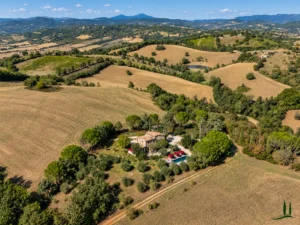
Buying property in the Val d’Orcia means buying into a UNESCO World Heritage landscape in the province of Siena. Official OMI values for ordinary homes ran from about 600 to 2,200 euro per square metre in late 2025, while asking prices on the portals sit far higher and fully restored farmhouses trade at a clear premium.
Key takeaways
- The Val d’Orcia covers five communes, Castiglione d’Orcia, Montalcino, Pienza, Radicofani and San Quirico d’Orcia, listed by UNESCO as a cultural landscape in 2004.
- Official OMI ranges for ordinary homes ran from about 590 euro per square metre in rural Castiglione d’Orcia to 2,200 euro in central Montalcino (2nd half of 2025), while portal asking averages reached roughly 2,300 to 3,400 euro in Montalcino, Pienza and San Quirico d’Orcia (immobiliare.it, 2025 to 2026).
- Sales in the province of Siena rose 13.6 percent in 2025 while average quotations stayed essentially flat (Agenzia delle Entrate, Rapporto Immobiliare 2026), strong demand without a price boom.
- You can restore, and often extend, inside the UNESCO landscape, but most external work needs a landscape authorisation with a binding opinion from the Soprintendenza.
- Planted Brunello vineyard at Montalcino was valued at roughly 250,000 to 1,000,000 euro per hectare, excluding buildings and improvements, in the latest CREA farmland survey (2024 data).
What exactly is the Val d’Orcia?
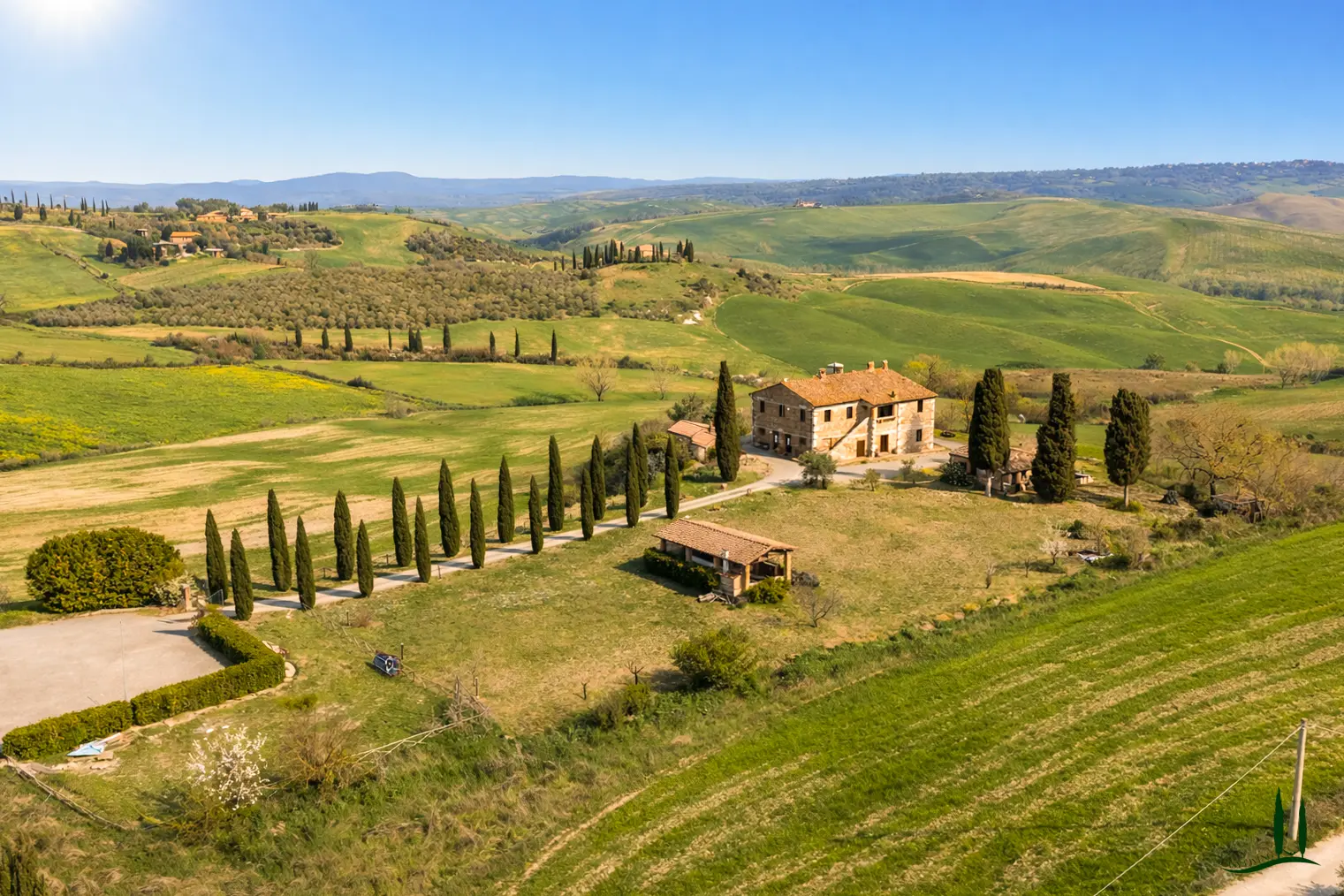
The Val d’Orcia is the valley south of Siena whose bare clay hills, cypress lanes and hilltop towns became the postcard image of Tuscany. It takes in five communes, Castiglione d’Orcia, Montalcino, Pienza, Radicofani and San Quirico d’Orcia, and UNESCO inscribed the whole territory in 2004 as a cultural landscape, a countryside deliberately redesigned in the Renaissance to embody good governance and beauty. The historic centre of Pienza has been a separate UNESCO site since 1996, so Pienza carries a double listing.
The valley is also a protected area, the Parco Artistico Naturale e Culturale della Val d’Orcia, created in 1999 by the five communes. The park is a management and protection body, it is not the office that grants building permits, those remain with each comune and the Soprintendenza. Two thermal spots anchor the lifestyle appeal: Bagno Vignoni, the village in San Quirico d’Orcia built around a Renaissance thermal pool, and Bagni San Filippo in Castiglione d’Orcia, with free hot springs and the white calcium formations of the Fosso Bianco.
How much does property in the Val d’Orcia cost?
It depends which of the two markets you are looking at. The official OMI quotations of the Agenzia delle Entrate, which track ordinary homes in normal condition, ran from about 590 to 2,200 euro per square metre across the five communes in the 2nd half of 2025. The international market for restored stone farmhouses with views is a different animal, and portal asking averages already sit far above the OMI bands: about 2,939 euro per square metre in Pienza (immobiliare.it, July 2025) and about 3,407 euro in San Quirico d’Orcia (immobiliare.it, June 2026).
| Commune | OMI range (2nd half 2025) | Portal asking average |
|---|---|---|
| Pienza | 1,300 to 1,850 euro / sqm in the historic centre, 1,100 to 1,500 in the countryside | about 2,939 euro / sqm (immobiliare.it, Jul 2025) |
| San Quirico d’Orcia | 900 to 1,650 euro / sqm across its zones | about 3,407 euro / sqm (immobiliare.it, Jun 2026) |
| Montalcino | 1,600 to 2,200 euro / sqm in the centre, 570 to 1,950 in the countryside depending on zone | about 2,347 euro / sqm (immobiliare.it, Aug 2025) |
| Castiglione d’Orcia | 590 to 1,050 euro / sqm | few homes advertised, no reliable average |
| Montepulciano (borders the valley) | 1,550 to 2,300 euro / sqm in the centre, 610 to 850 rural | about 1,606 euro / sqm (immobiliare.it, Feb 2026) |
The gap between the two columns is the story of the Val d’Orcia. Ordinary local stock changes hands near the OMI bands, while the limited pool of restored farmhouses and view estates is priced for an international audience. Where the OMI tracks villas as a separate category the premium shows up in the official data too: in the Montalcino countryside, ville e villini are quoted at 1,850 to 2,750 euro per square metre, against 1,300 to 1,950 for ordinary homes in the same zone (OMI, 2nd half of 2025). The market is busy but not overheating: 3,614 homes changed hands in the province of Siena in 2025, up 13.6 percent on 2024, while average quotations edged down 0.6 percent (Agenzia delle Entrate, Rapporto Immobiliare 2026). Our guide to Tuscany property prices by area puts these numbers in the regional context, and our guide to the cost of buying property in Italy covers the taxes and fees you pay on top.
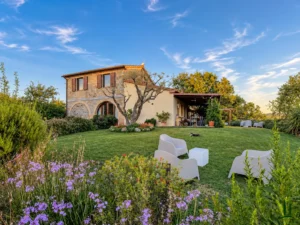
What does that mean in practice? In our own catalogue, a country villa with pool near the thermal baths asks about 1.09 million euro, a restored 19th century stone farmhouse at Montalcino about 1.1 million euro, and a 475 square metre stone farmhouse with sweeping Val d’Orcia views 2.6 million euro. These are single properties, not a market average. If the valley’s premium stretches the budget, the Tuscan Maremma offers similar stone and cypress country at softer prices, and our guide to the cheapest areas to buy a house in Tuscany maps the value end of the region.
Can you build or extend in a UNESCO landscape?
You can restore, and in many cases extend or adapt, but you cannot treat the Val d’Orcia like open countryside. Practically the whole valley sits under a vincolo paesaggistico, the landscape protection order that Italian law places on areas of scenic value. Any work that changes the external appearance of a property needs an autorizzazione paesaggistica, the landscape authorisation issued under article 146 of the heritage code: you apply through the comune, the Soprintendenza in Siena gives a binding opinion within 45 days, and lighter works can use a simplified route with a 20 day opinion. Interior renovation that leaves the outside untouched is generally outside the landscape procedure.
Expect the classic conditions of a protected landscape: traditional materials such as stone and terracotta, restrained extensions, and effectively no new scattered building in the open countryside. The exact rules sit in each comune’s Piano Operativo, so confirm them with the local planning office and a geometra, the Italian building surveyor who typically manages this paperwork. One nuance worth knowing: under national law rooftop solar panels no longer need landscape authorisation on most buildings, and even in historic centres and decree protected areas they generally remain free when integrated into the roof and not visible from public viewpoints. Visible panels, or panels on traditional terracotta roofs, still need authorisation in those zones, so check the specific vincolo before you plan them.
Where should you buy: Montalcino, Pienza or San Quirico?
Pick by lifestyle, because each town has a distinct character and its own price logic.
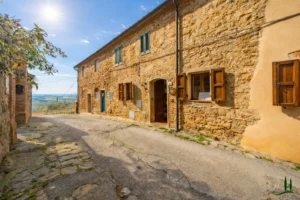
Montalcino is the working wine capital, home of Brunello and of a real year round economy. It pairs the valley’s most liquid rental and resale demand with genuine services. Our wine country farm near Montalcino, asking about 1.15 million euro, shows the type of property the town commands.
Pienza is the Renaissance showpiece, rebuilt from 1459 for Pope Pius II, with the double UNESCO status and the strongest tourist footfall, plus the village of Monticchiello in its territory. San Quirico d’Orcia, with Bagno Vignoni, sits at the exact centre of the postcard landscape, which is why its asking average is among the highest in the valley. Castiglione d’Orcia and Radicofani are the value end, quieter, higher and cooler, with the free springs of Bagni San Filippo on the slopes of Monte Amiata.
Montepulciano, on the ridge between the Val d’Orcia and the Val di Chiana and just outside the UNESCO perimeter, is the pragmatic compromise: Vino Nobile cellars, a full service town and asking averages around half of Pienza’s. A recently renovated modern villa with pool steps from the centre of Montepulciano asks about 1 million euro in our catalogue. If you plan to let your home to holiday guests, demand across the whole valley is strong, and our guide on renting out a Tuscan property and the CIN code explains the rules.
Can you buy a Brunello vineyard?
Yes, but scarcity sets the price. The Brunello di Montalcino growing area has been capped at roughly 2,100 hectares since 1997, and the Consorzio counted 219 member producers in 2025, so estates rarely reach the open market. The latest CREA farmland survey (2024 data) valued planted Brunello vineyard at roughly 250,000 to 1,000,000 euro per hectare, excluding buildings and improvements, among the highest values in Italy. Figures move with vintage reputation and parcel quality, so confirm any valuation with your own advisor. For off market opportunities, vineyard and estate searches are exactly what our property finding service exists for.
How far is the Val d’Orcia from an airport?
Plan on Florence or Rome for most flights. From Pienza, Florence airport is about 120 to 140 kilometres depending on the route, roughly an hour and a half to an hour and 50 minutes by car, Perugia airport about 94 kilometres, and Rome Fiumicino about 2.5 to 3 hours. Siena is about an hour and a quarter. By rail, Chiusi-Chianciano Terme station on the conventional Florence to Rome line is about 45 minutes from Pienza, and Buonconvento station on the Siena to Grosseto line serves the western valley. The hospital for the area is at Nottola near Montepulciano, with an emergency department, about half an hour from Pienza.
Frequently asked questions
How much does a farmhouse in the Val d’Orcia cost?
Ordinary homes are quoted by the OMI at roughly 590 to 2,200 euro per square metre depending on commune and zone (2nd half of 2025), but restored farmhouses with views are a premium market priced well above those bands. In our current catalogue, restored country properties in the valley run from about 1 million to 2.6 million euro. These are single listings, not an average.
Can I build or extend in the UNESCO zone?
Renovation and sensitive extensions are possible, new scattered building in open countryside effectively is not. External work needs a landscape authorisation, with the comune handling the file and the Soprintendenza giving a binding opinion within 45 days, 20 days on the simplified route for lighter works. Rules differ by comune, so verify your project with the local planning office and a geometra before you buy.
Should I choose Montalcino or Pienza?
Choose Montalcino for a working wine town with a year round economy and the Brunello name, choose Pienza for the Renaissance showpiece with the strongest tourism. San Quirico d’Orcia is the postcard centre and its asking average, about 3,407 euro per square metre (immobiliare.it, June 2026), is among the highest in the valley, while Castiglione d’Orcia is the value option.
Which villages are part of the Val d’Orcia?
The UNESCO site covers five communes: Castiglione d’Orcia, Montalcino, Pienza, Radicofani and San Quirico d’Orcia, including villages such as Bagno Vignoni, Rocca d’Orcia and Monticchiello. Montepulciano lies just outside the UNESCO perimeter, on the ridge towards the Val di Chiana, and is often searched together with the valley.
Is the Val d’Orcia a good investment?
It is a scarcity market rather than a growth story. Transactions in the province of Siena rose 13.6 percent in 2025 while official quotations stayed flat (Agenzia delle Entrate, Rapporto Immobiliare 2026), and the stock of restorable farmhouses inside the UNESCO landscape is finite. Buy a quality property in a strong position, plan to hold, and let holiday rental demand support the running costs.
How we can help
Easy Living Tuscany is a boutique agency that works across the Val d’Orcia, Montalcino and Montepulciano. If you want a shortlist built around your budget, including estates that never reach the portals, use our property finding service, browse what is currently for sale, or book a call for an honest read on each town. For the wider picture, start with our pillar guide to buying property in Tuscany.
These figures are indicative, confirm your specific case with your notary, tax advisor, surveyor or the relevant consulate.
Last updated August 2026. Written by Alessandro Ciacci, Co-founder, Easy Living Tuscany.